6644 Odin Street (Relocated)
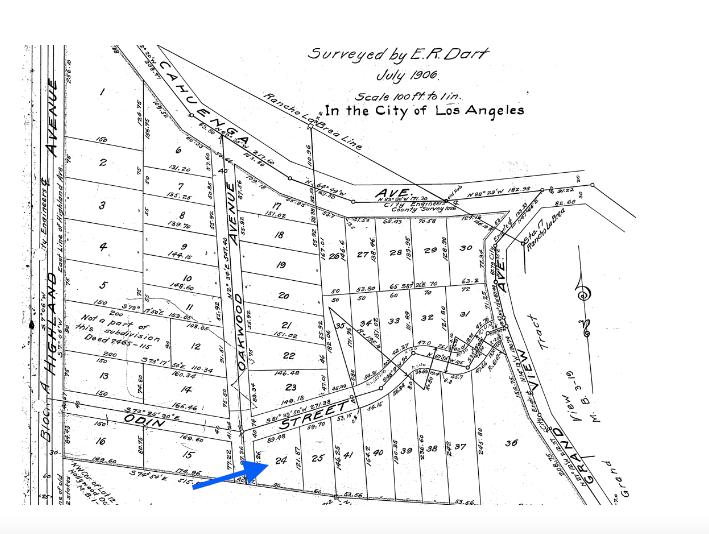
Before Whitley Heights was divided by the 101 Freeway in the 1950s, Odin Street ran west from Whitley Terrace, crossed Highland Avenue and ended in the foothills of Hollywood. A small part of the road that had been left off of Whitley Terrace is now called Lash Lane. There is another part of Odin Street that exists off Cahuenga Terrace which was formerly Fairfield Avenue. The rest of Odin Street was demolished, including lot 24 that was once located on Lockland Place Tract. Below, an early tract map of the area when Whitley Terrace was once called Grand View Avenue and Fairfield Avenue was named Oakwood Avenue when the area first became Whitley Heights.
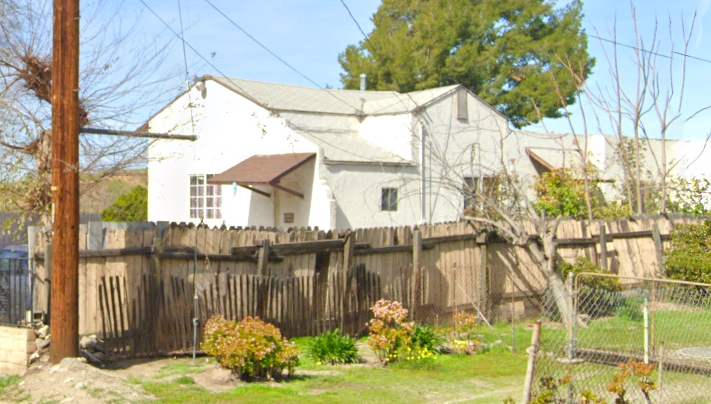
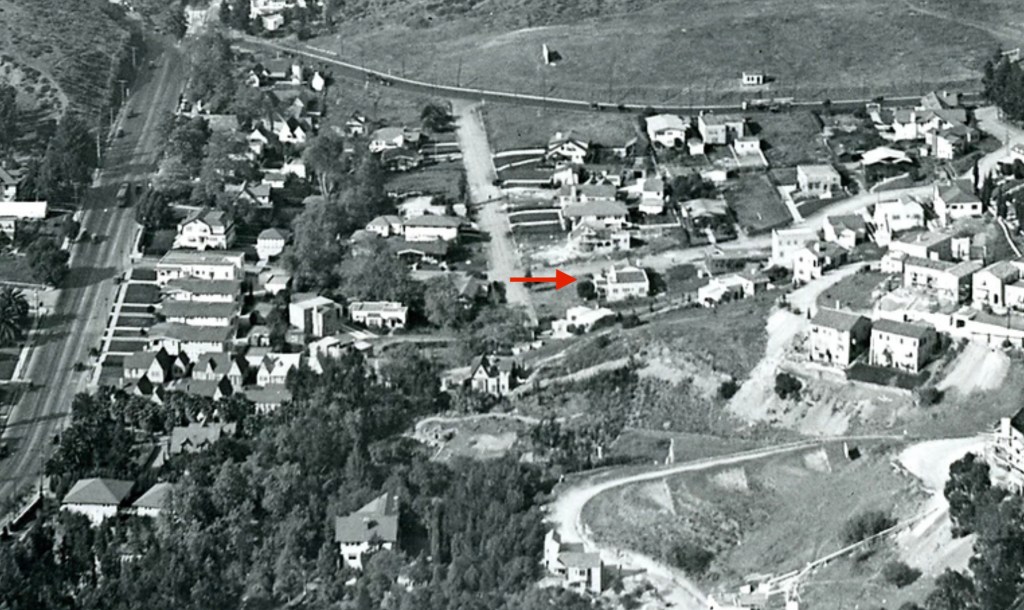
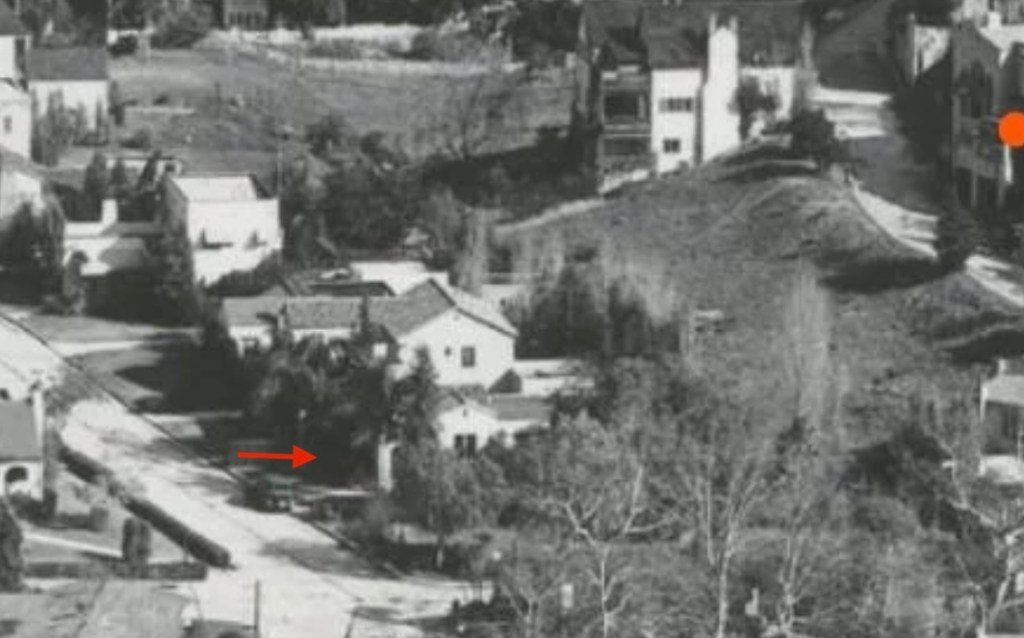
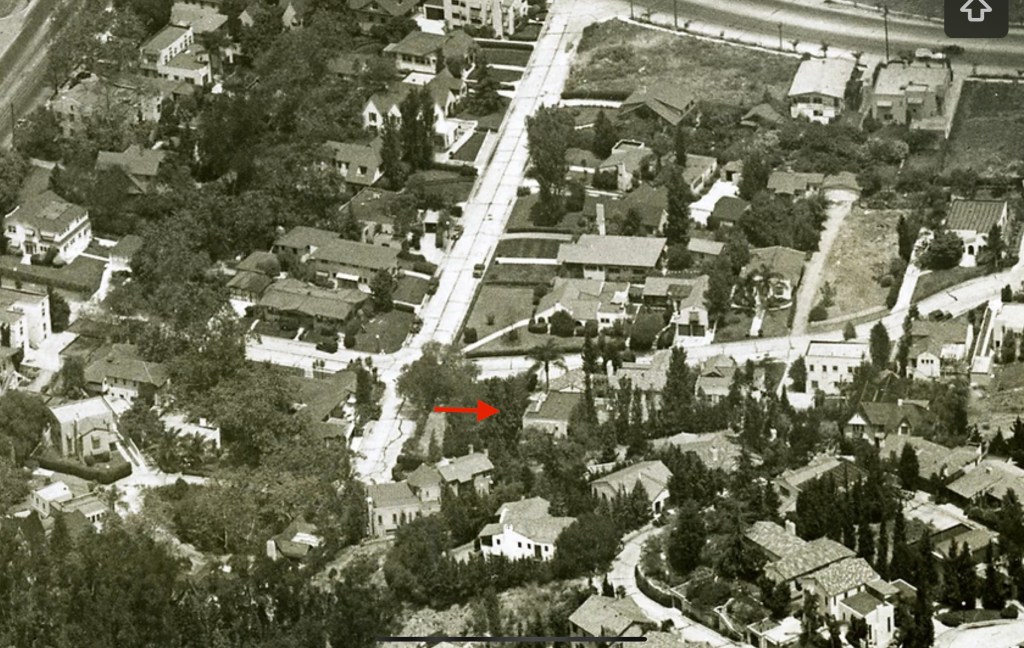
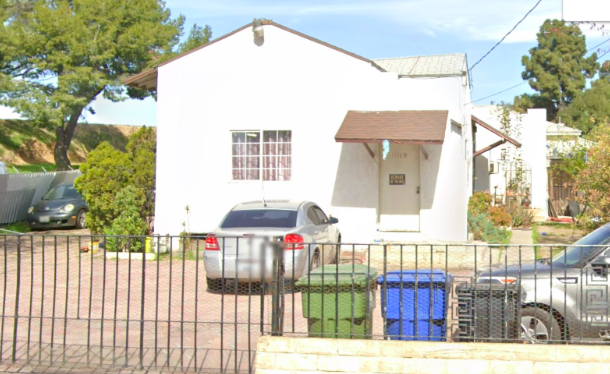
Fortunately, the 1,461 square foot house, that has two bedrooms and one bathroom, was auctioned off and relocated to 11149 Strathern Street in Sun Valley in 1951. Many of the homes in Whitley Heights were built in the 1920s, and some had been relocated but then demolished later since they were no longer part of the historic district. This property, so far, has been spared. The house was originally built in 1921 by George and Belle Perry, who lived in the home with their daughter, Georgia, an elementary school teacher. The Perry’s sold the property after George’s death in the mid-1920s. Below, aerial photos of Odin Street showing the home located at 6644 Odin Street.
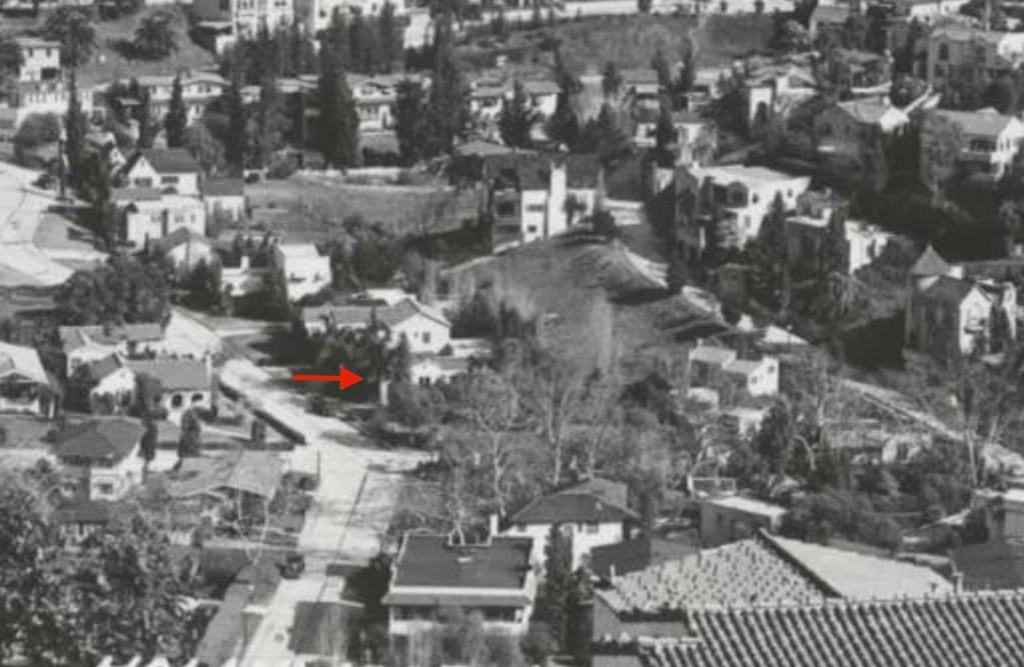
Below, a red arrow indicating 6644 Odin Street and an orange dot near 2133 Fairfield Avenue, one of three homes left on that street that exist today.
One notable tenant was German architect and set designer Carl Jules Weyl (1890–1948) and his wife, Irma, in 1933. Weyl was born in Stuttgart, Germany. His father, Karl Friedrich Weyl, was an architect and field engineer of the Gotthard Rail Tunnel through the Alps. Carl Jules Weyl studied at the École des Beaux-Arts in Paris after architectural training in Berlin, Strasbourg, and Munich. He served as a first lieutenant of infantry in the German Reichswehr, according to his World War I draft registration card.
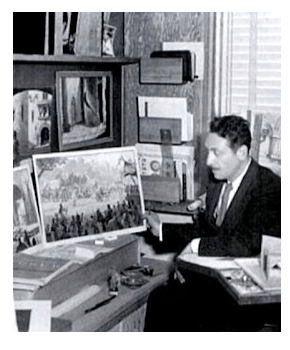
Weyl immigrated to the United States in 1912, and worked as an architect in California, first in San Francisco for the architect John W. Reid, Jr., a designer of the San Francisco Civic Center and many schools. Weyl then moved to Los Angeles in 1923, where he designed the second Brown Derby Restaurant, the Hollywood Playhouse, the Fred Thompson building, Bendix Building, Sunset Western Market, the Gaylord Apartments, as well as many other buildings and Hollywood estates.
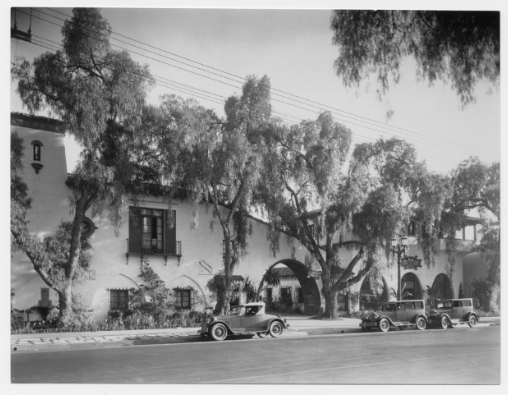
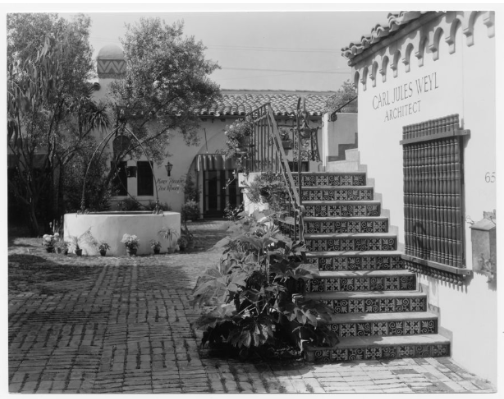
Above is the Fred Thompson Building, a.k.a. the Court of Olive, because of a olive tree that sits in the center of the courtyard, located at 6530 Sunset Blvd. In 1927 cowboy actor, Fred C. Thompson wanted to built an investment property at that location. He hired architects Carl Jules Weyl and his business partner, Henry Gogerty to design the 2 story Spanish shopping complex that contained a courtyard. Weyl even had his business located at the building.
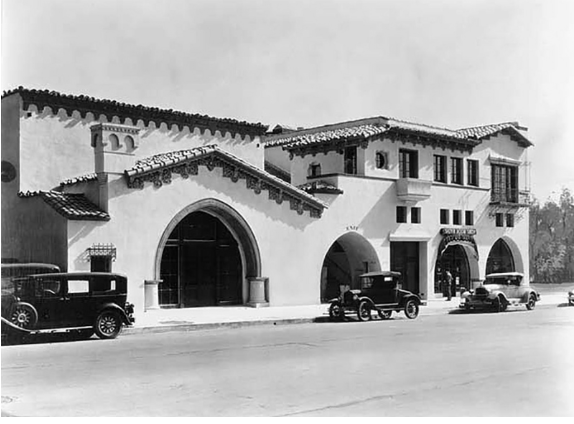
Weyl was also responsible for building design of the second Brown Derby Restaurant. The original Brown Derby was shaped like a derby hat and opened in 1926. The second Brown Derby, pictured below, was designed with a Spanish facade and opened in 1929. This newer Brown Derby was closer to the movie studios and attracted the celebrities. An episode of I Love Lucy was filmed inside and was the restaurant where the Cobb Salad and the Shirley Temple were invented. The restaurant at this location closed in 1985 due to a lease dispute.
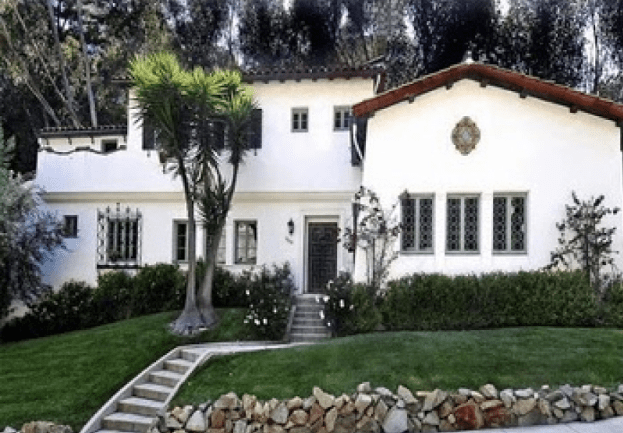
Weyl had a productive business in Los Angeles in the 1920s and he was able to design and live in his own home that was built in 1930 at 2015 N. Curson Avenue. Below, the front of his house has the Spanish features that many of his other buildings also had. Singer Kurt Cobain’s daughter, Frances Bean Cobain, purchased the home in 1918 and recently sold it to move to San Diego.
Carl Jules Weyl did not move to 6644 Odin Street until 1933 during the Great Depression when his business went under as little construction was happening. Weyl was able to join Cecil B. DeMille Productions and then Warner Bros. as an art director. He was credited for 48 movies between 1935-1947 including; The Adventures of Robin Hood (1937), The Letter (1940), Casablanca (1942), Saratoga Trunk (1945), and The Big Sleep (1946). Weyl won an Academy Award for his set design for The Adventures of Robin Hood. Obviously, the economy did not affect Weyl’s financial situation for very long and he was able to move out of the tiny 2-bedroom house the following year.
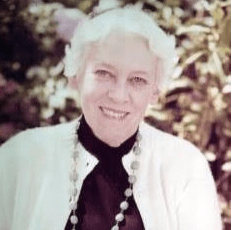
The next tenant was editor Frank T. Pope and his wife, Alma. At one time, Frank was the managing editor of The Hollywood Reporter, a publication that was founded by Billy Wilkerson in 1930. This publication is still in existence today, but operates as a website. Frank was also the editor for Photoplay magazine in 1923. The Pope’s daughter, Nancy, pictured below, also resided with them at this house. They previously resided in another Whitley Heights home, 6654 Alta Loma Terrace, in 1931. Nancy was a writer and former society editor of the Hollywood News. In 1936, Nancy became engaged and married to Aristides Mayorga. Apparently, Nancy signed up for a Spanish class at the Hollywood Evening High School. Mayorga happened to be her Spanish teacher. When they married, Nancy had already published two books. After they were married, she published several more. Most recently, The Hunger of the Soul, a diary of her spiritual journey.
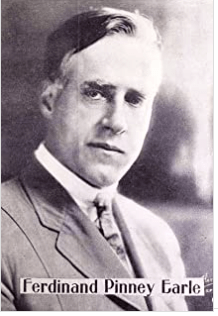
In 1942, artist, set director, and poet, Ferdinand Earle and his Belgian wife, Denise resided at 6644 Odin Street. Denise Loncin Earle, was the official painter for the Belgian court. They were forced to leave their home in St. Jean De Luz, France after residing 10 years there; they fled the Nazi invasion leaving behind their art treasures and all of their belongings. Ferdinand had 19 movie credits in set direction, most notably assisting with Ben-Hur in 1925.
 Whitley Heights 101
Leave a comment