6764 Wedgewood Place
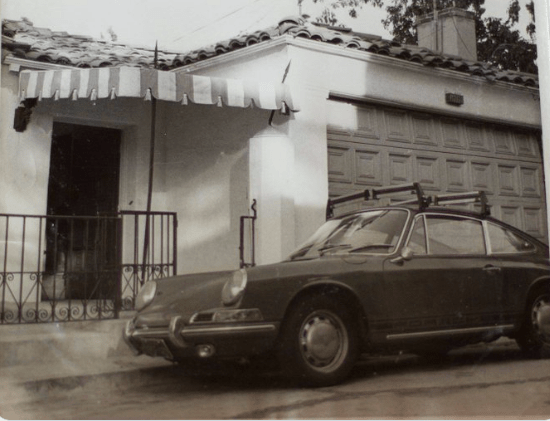
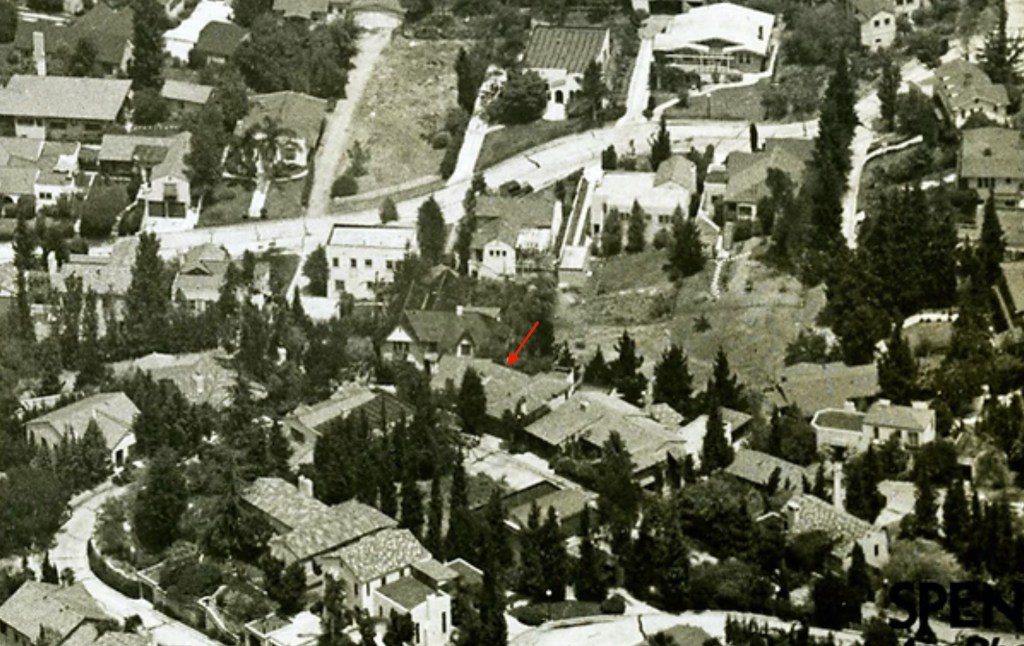
6764 Wedgewood Place was built in 1927 by architect Nathan Coleman. The owner, A.C. Walker, had also built 2055-7 Las Palmas Avenue in 1929 (see previous post). Used primarily for a rental, the two story home was on a downslope on Wedgewood Place and consisted of eight rooms. Below the property is seen to the left of 6766 Wedgewood Place which was also torn down. There is a vacant lot to the right of 6766 Wedgewood Place and then 6766 Wedgewood Place, the former home of Rudolph Valentino. 2221 Fairfield Avenue can be seen to the right and below 6764 Wedgewood Place.
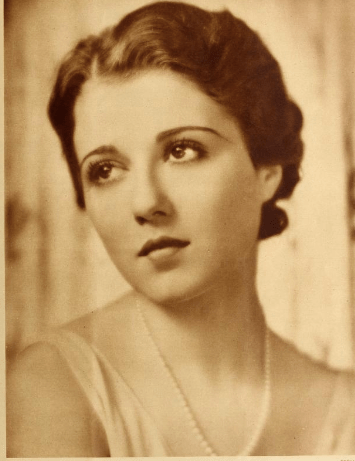
The first tenant to rent 6764 Wedgewood Place was actress, Sidney Fox. Fox, who was born in 1907 with the name of Sarah Liefer, had just moved to Hollywood to work for Universal Studios. Fox, who still considered New York to be her home as she acted on stage for many years, decided to rent rather than live in a hotel. Universal’s producer Carl Laemmie, discovered her while she was on stage and signed her to a multi-year contract. Apparently, he also had other ideas for her as it was rumored the two were having an affair for several years. Fox debuted in 1931’s “Bad Sister” with Conrad Nagel, Humphrey Bogart and Zazu Pitts. That same year, she was selected as one of the WAMPAS baby stars, but only completed a total of roles between 1931-1934.
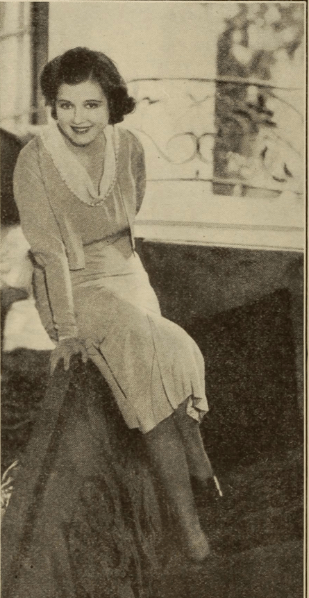
Fox, seen in the Wedgewood Place home above during an interview, began filming The Murders in the Rue Morgue with Bela Lugosi in 1932. In May of 1932, she was backing her heavy coupe out of her garage and when preparing to turn sharply, the car slipped off of the road and fell off of the embankment and tumbled down the hill being stopped by a tree. Fox backed out of the garage going to the left of the house since 6758 Wedgewood Place had not been built yet and the property was an empty lot. 6766 Wedgewood Place was to the right of her home and was built in 1924. The car did a complete somersault down the embankment and landed upside down against the tree. Surprisingly, Fox was able to walk away from the car without any injury. The Los Angeles Times erroneously listed her as living at 6774 Wedgewood Place. Not surprisingly, Fox moved out of 6764 Wedgewood Place after the accident.
Fox met and married literary agent Charles Beahan in December of 1932 and they rented a home in the Beverly Hills Flats section (no more hills for Fox) at 9421 Charleville Blvd for $125 per month. It is unclear whether Fox was still having relations with Laemmie after she wed, but the roles stopped suddenly in 1934 and she went back to theater. On November 14, 1942, Beahan found Fox dead in their bed from an overdose of sleeping pills that was ruled “an accident”. Fox was just 34 years old when she died.
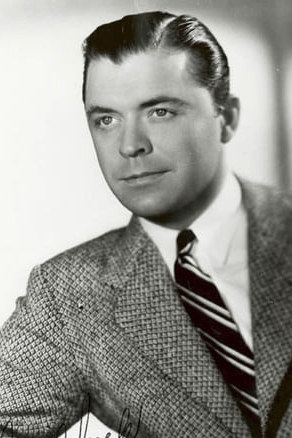
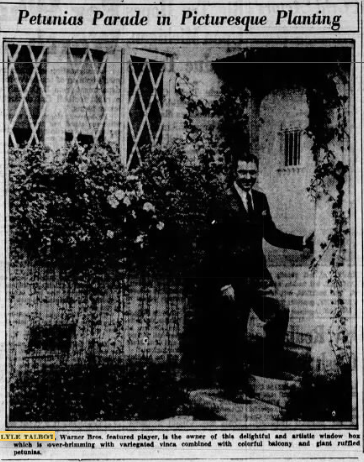
Following Fox’s departure was actor Lyle Talbot from 1935-1937. Talbot began his film career under contract with Warner Bros. during the early years of the sound era. Ultimately, he appeared in more than 175 productions with various studios, first as a young matinee idol, then as the star of many B movies, and later as a character actor. Below, Talbot is seen in front of the 6764 Wedgewood Place home in 1933.
He was a founding member of the Screen Actors Guild and in 1933 served on that organization’s first board of directors. The studio may have penalized Talbot for his role at the Screen Actors Guild as he was only able to get small parts. Talbot also had a drinking problem which may have been noticed as well.
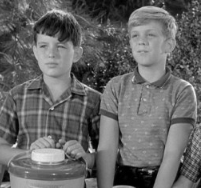
He guest starred on many popular television shows such as Leave it to Beaver, The Adventures of Ozzie and Harriet, The Lone Ranger, The Beverly Hillbillies, Charlie’s Angels, Newhart, The Dukes of Hazzard, Adam-12 and Who’s the Boss. Talbot actually starred in Leave it to Beaver with his son, Stephen, who played Gilbert Bates, the friend of Beaver.
Talbot had been married five times: Elaine Melchior (1930), Marguerite Cramer (1937-1940), Abigail Adams (1942-annulled same year), Keven McClure (1946-1947), and Paula Deaven aka Margaret (1948-her death in 1989). In October of 1933, while living on Wedgewood, Talbot was driving his car on Whitley Terrace and hit the curb crashing into 6813 Whitley Terrace which totaled the car and took a chunk out of the corner of the home. Talbot suffered a skull fracture, multiple lacerations and was in critical condition but survived. 6813 Whitley Terrace is still in existence today and uses the address of 6814 Iris Circle.
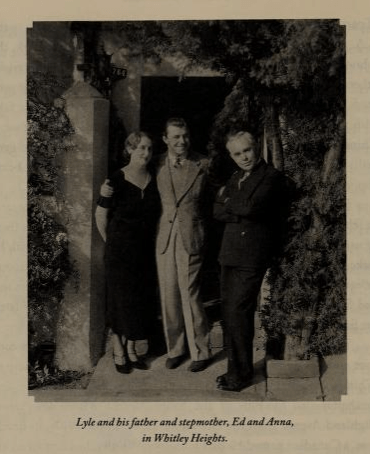
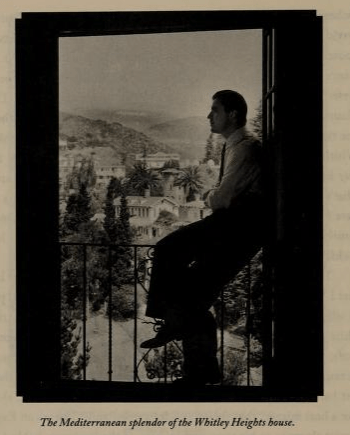
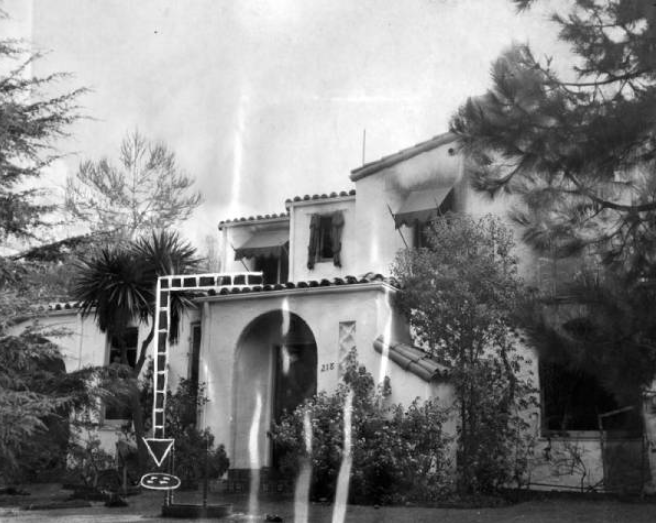
In December of 1937, Talbot married his second wife, Marguerite Kramer. Below, they are pictured in front of the house in Whitley Heights. After they got married, they moved to a home located at 218 S. Peck Road in Beverly Hills.
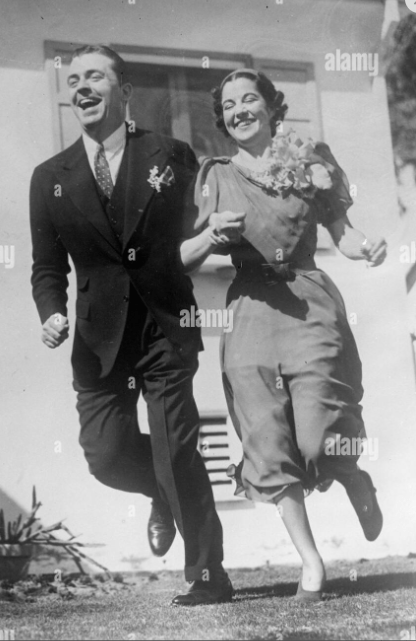
In October 25, 1938 friend and actor, Franklin Parker, spent the night at the Peck Road residence after a night of partying. Apparently, someone left a lit cigarette downstairs that caught on fire. Talbot and his guest, actor Franklin Parker, were sleeping when the fire broke out. Awakened, Talbot dragged Parker to a window, tore off the man’s blazing pajamas and hoisted him out on a ledge. The rescuers arrived and Talbot jumped 20 feet, as shown by the dotted line below, and Parker was saved.” Both Talbot and Parker suffered second and third degree burns and were both hospitalized. Once again, Talbot recuperated, but his house and his marriage did not survive.
Finally, his fifth marriage seemed to be the real deal. He married for the fifth time in 1948 to Margaret Epple, a young actress and singer who adopted the name “Paula” and sometimes went by the stage names of “Paula Deaven” or “Margaret Abbott.” She was 20; he was a 46-year-old actor with a drinking problem. Under Paula’s influence, Talbot quit drinking, and the couple often performed together on stage in summer stock and community theater. They had four children, lived in Studio City, California (where Talbot was honorary mayor in the 1960s), and remained married for more than 40 years, until Paula’s death in 1989. His son, Stephen went on to become a producer and daughter, Margaret, writer for the New Yorker, the daughter of the veteran Warner Bros. actor Lyle Talbot, whom she profiled in an October 2012 The New Yorker article and in her book The Entertainer: Movies, Magic and My Father’s Twentieth Century (Riverhead Books, 2012). David Talbot, another son, founded online news, salon.com. After Paula died, Talbot moved up to San Francisco where his two sons lived and died at the age of 94.
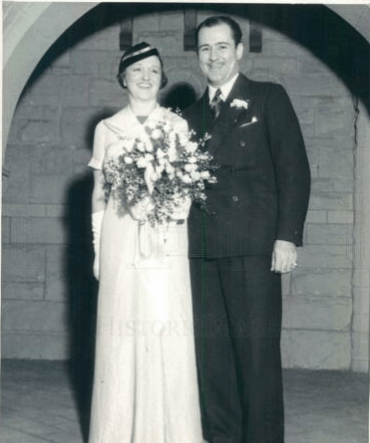
Following the Talbot departure, actor Walter A. Merrill and his mother, Elsie, moved into the home. Merrill remodeled the basement into a studio apartment for the maid. Merrill was credited for 95 minor acting roles between 1925 and 1962. He was known Justice Takes a Holiday (1933), Parlor, Bedroom and Bath (1931) and While London Sleeps (1926). He married actress Julia Faye in 1935 (both pictured above) and moved her in Wedgewood Place and the three lived there together: Merrill, his new bride and her new mother-in-law.
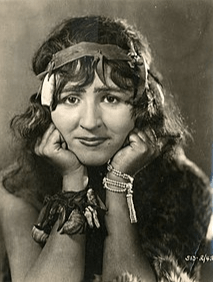
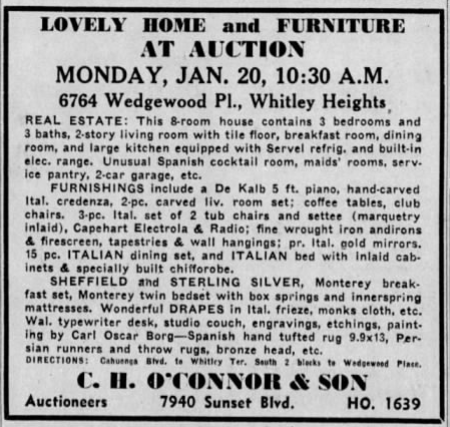
Julia was born Julia Faye Maloney in 1892 and discovered by Cecil DeMille. She was known for her appearances in more than 30 Cecil B. DeMille productions. Her various roles ranged from maids and ingénues to vamps and queens. She was “famed throughout Hollywood for her perfect legs” until her performance in Cecil B. DeMille’s The Volga Boatman (1926) established her as “one of Hollywood’s popular leading ladies.” She was also known for her affair with DeMille which may have influenced her career. In April 1936, she announced that she had obtained a Nevada divorce from Merrill. Whether the marriage was failed to doom due to the fact that it was a sudden marriage, or having to live with a mother-in-law, or the DeMille affair, Julia moved on from Whitley Heights and Merrill and his mother followed by auctioning the house and all of its belongings:
Actor Eric Linden moved in by 1939 and only stayed one year. Linden (1909-1994), was once called by RKO, “The Boy Sensation of the Theater Guild,” he later was pegged as Hollywood’s tragic boy actor on the screen. Other roles came with The Crowd Roars (1932) as James Cagney’s hero-worshiping brother, a collegiate lead in The Age of Consent (1932), the immature son of Lionel Barrymore in Sweepings (1933), the young male lead in The Past of Mary Holmes (1933), the dominated son of Laura Hope Crews in The Silver Cord (1933) and then performed one of his last good film roles in Ah Wilderness! (1935) opposite Barrymore again, Wallace Beery and Mickey Rooney. One of his biggest disappointments at the time was losing the part of Laurie in the classic Alcott tearjerker Little Women (1933).
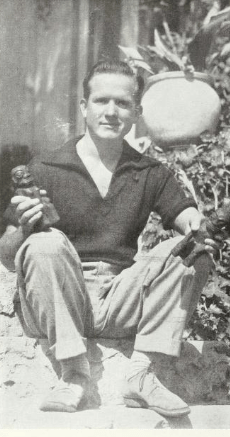
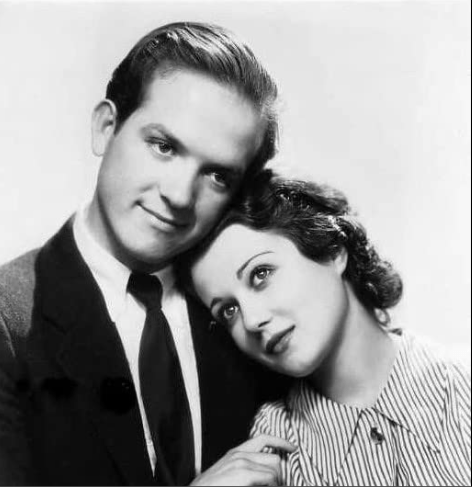
Good parts declined into minor roles the late 1930s and, following diminishing work in such films as Robin Hood of El Dorado (1936), The Good Old Soak (1937), Here’s Flash Casey (1938) (title role), Everything’s on Ice (1939) and, his last, Criminals Within (1941), Eric left films for good. During this time, he also had a very small role as a Civil War amputee in Gone with the Wind (1939). Linden went back to the theater and had a very successful career on stage. He also appeared with Sidney Fox in Afraid to Talk in 1932 (both pictured below) while she was residing in this home; a “six degrees of separation” link?
Hollywood artist, Ruby Usher, her husband, Frederick, and two sons settled into 6764 Wedgewood Place in which they remained until Ruby’s death in 1957. Rudy was a distinguished painter and sketch artist and won medal of honor Pennsylvania Academy of Fine Arts in 1941. Her studio was in the home where she kept the majority of her work. In 1943, an undetermined fire broke out in the home and destroyed most of her artwork. Some of her artwork is still sold in auctions today.
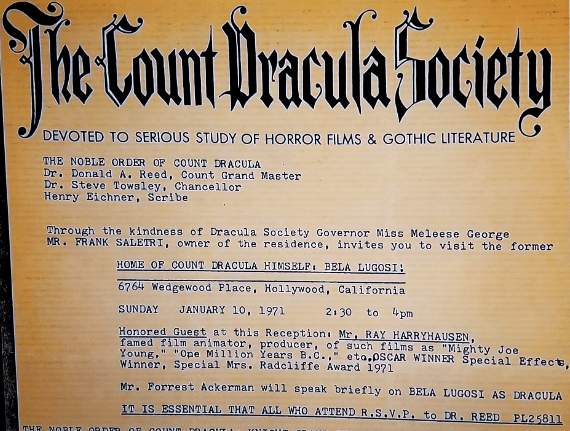
The last homeowner was lawyer Frank Saletri who bought it in the mid-1960s. Saletri claimed the house was owned by actor Bela Lugosi because he found a scrapbook that contained clippings about Lugosi and just assumed that it belonged to him. Others have researched this claim and presently, there is no evidence the Lugosi ever lived in the home. Saletri hosted a Count Dracula Society engagement in the home on January 10, 1971:
During the event, some photographs were taken of inside the home and it’s gothic decor:
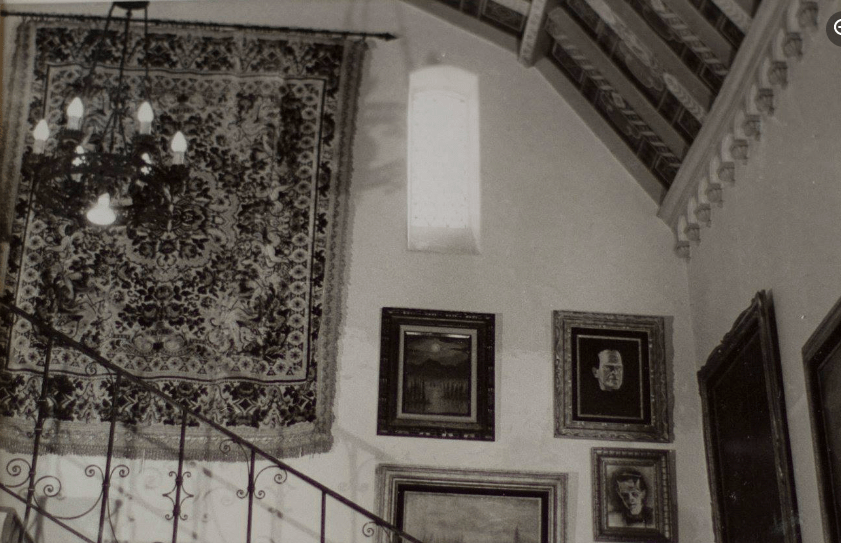
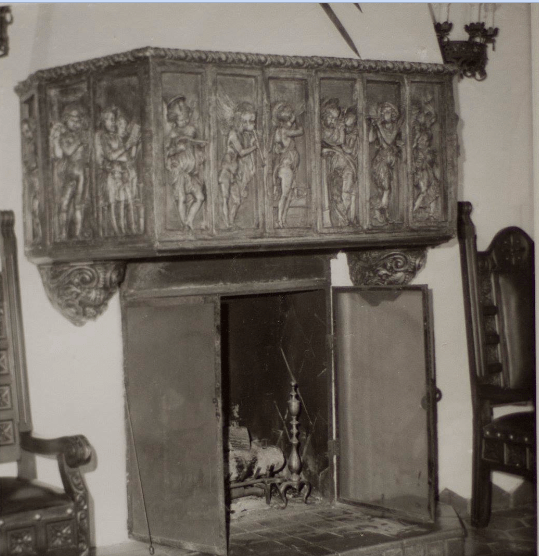
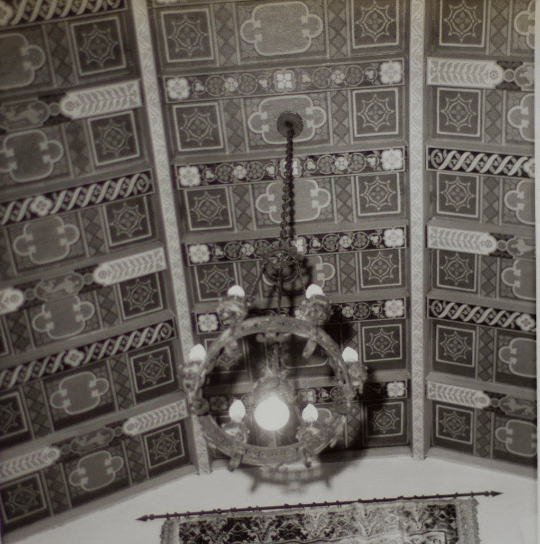
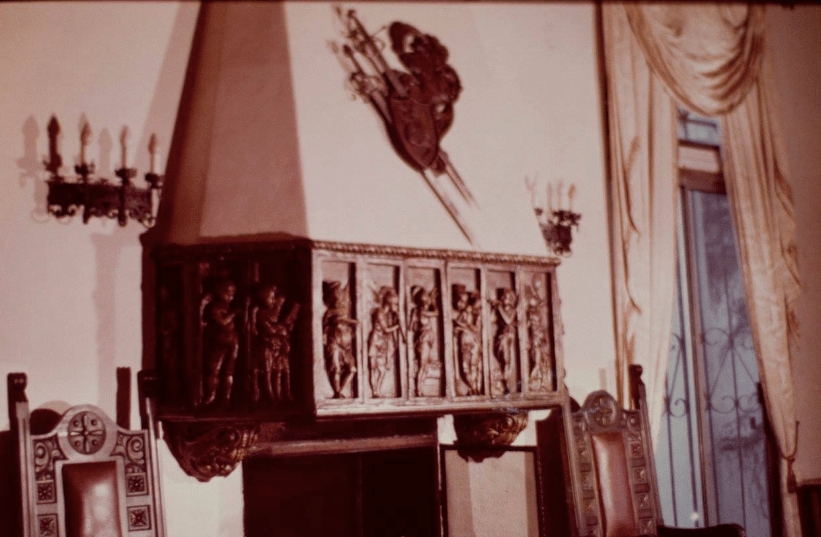
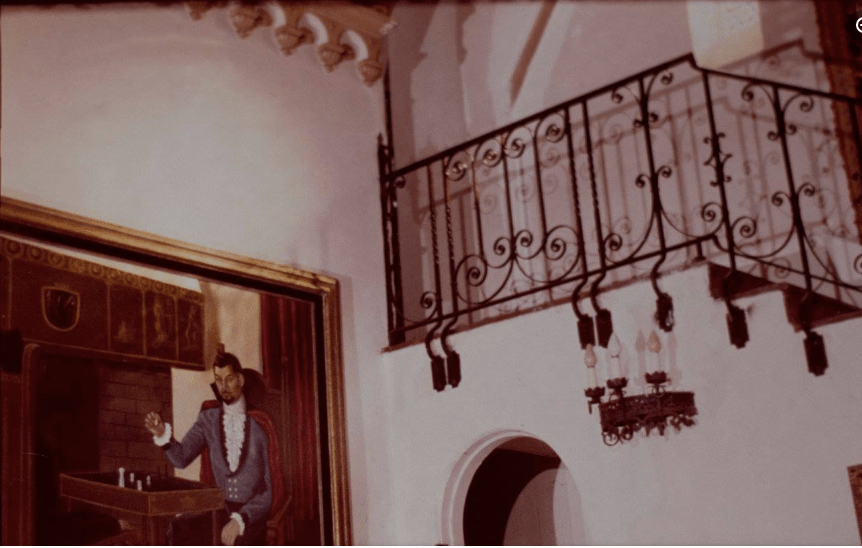
It was alleged that Lugosi’s “Haunted Mirror” was left in the home with other furniture as the home was only a rental. In 1971, 6764 Wedgewood Place was razed due to the widening of the 101 Freeway. Saletri was upset he had to leave, but supposedly took the mirror and moved across the freeway to 6216 Primrose Avenue. This is around the time Saletri wrote the screenplay to the movie spoof, “Blackenstein”. Saletri, a known criminal defense lawyer who was famed for defending the 48-year-old stripper who had once performed a well-publicized, one-block “streak” in Hollywood. He also tried to get acting parts in the 1950s and went by the stage name “Kane Corday”.
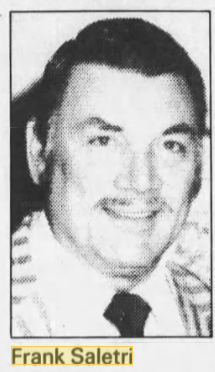
Saletri was found shot to death in his head in the Primrose home in July of 1982 (pictured below). The intruder confronted Saletri in the master bedroom, bound the lawyer up by his arms and legs, and, in classic gangland execution style, pumped one bullet into the back of Saletri’s head. He had “screwdrivers to the back of the elbows, to the knees, to the back of the head. He was shot, and that screwdriver dug out those bullets.” The intruder then left and to this date, the murder remains unsolved. Apparently, Saletri put the mirror he took from Wedgewood and put it in his bedroom and some claim that the mirror is some type of a “portal” to negative energy. However, even if the mirror does not belong to Lugosi, there may be some truth to the portal as evidenced by all the unfortunate events many of the Wedgewood inhabitants have endured. (Just my opinion). Perhaps, this is the one house that was fortunate to be destroyed. Wonder who has the mirror now!

 Whitley Heights 101
Leave a comment