6746 Milner Road
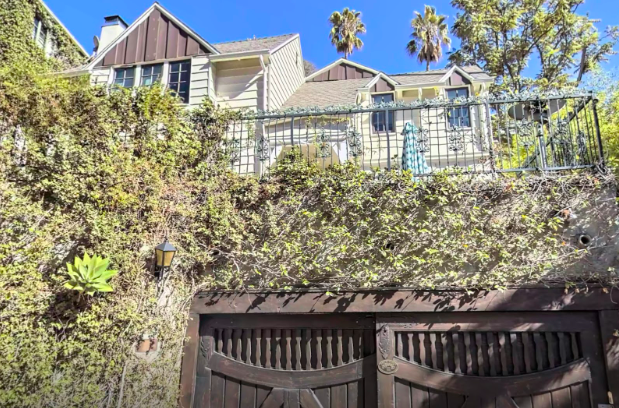
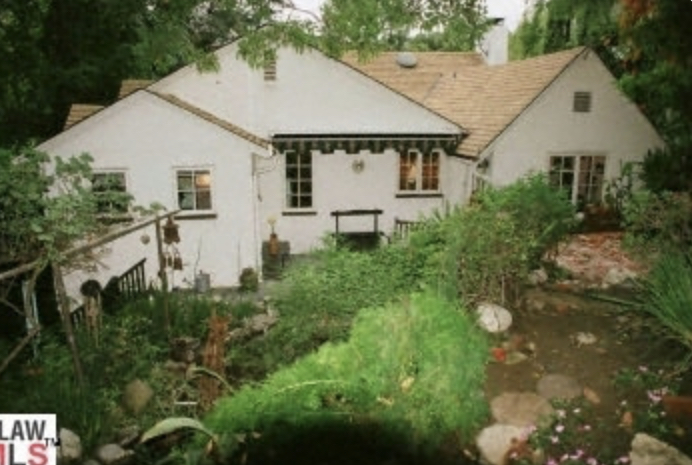
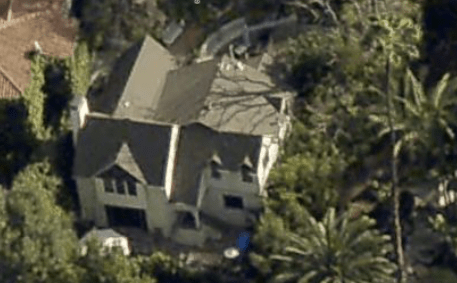
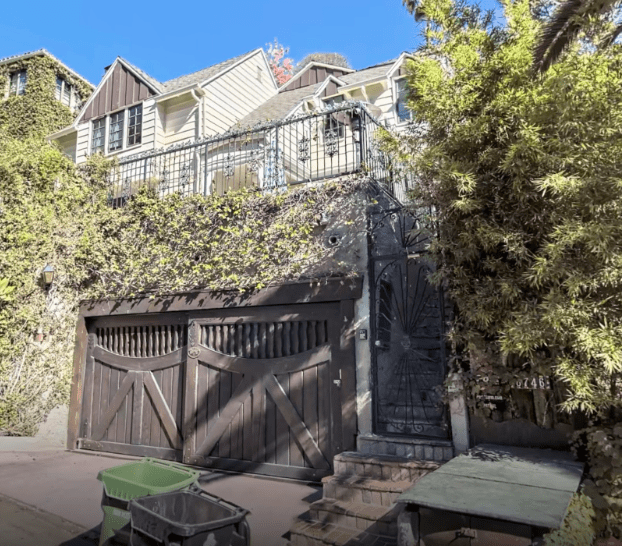
6746 Milner Road was built in 1923 (formerly named 6767 Milner Court) by architect Benjamin B. Horner. The exterior of the house was originally in Mediterranean style stucco, but now has aluminum siding, a composition roof, and French doors and windows. The two story home that sits on an upslope has a total of 1,868 square feet with 4 bedrooms and 3 baths. In 1964, the fourth bedroom was added.
Benjamin Horner (1893-1971) was a well-known architect of the Los Angeles and Santa Barbara areas in the 1920s. He also designed several other Whitley Heights homes including; 6627 Emmet Terrace (Jean Parker’s former residence), 6658 Emmet Terrace, 6662 Emmet Terrace, 6747 Milner Road (Jack Mulhall’s former residence), 6753 Milner Road (Crauford Kent’s former home), 6757 Milner Road and 6760 Milner Road. Horner built 6747 Milner Road for actor Jack Mulhall and other celebrity client’s included actor Noah Beery and actress Carol Dempster.
Horner was born in Michigan to William C. Horner, a draftsman for a furniture company and Emily Horner, both immigrants from England. Horner graduated from Purdue University and then served in the Army Engineering Corps during World War 1. He was living in Los Angeles by 1920 and was working as a technical engineer in the machine manufacturing industry. By 1930, Horner was married to his first wife, Adelaide and now working as a civil engineer. In the late 1930s Horner remarried and had three sons. The Horners were living in Santa Barbara until 1948 when they moved to Ojai. Horner visited England during the 1920s and photographed historic buildings, manor houses and villages. He also photographed early historical structures in Southern California. The Horner Architectural Photograph Collection is available to view online through the Cal Poly Kennedy Library Online Archive: https://digital.lib.calpoly.edu/rekl-horner-ms110
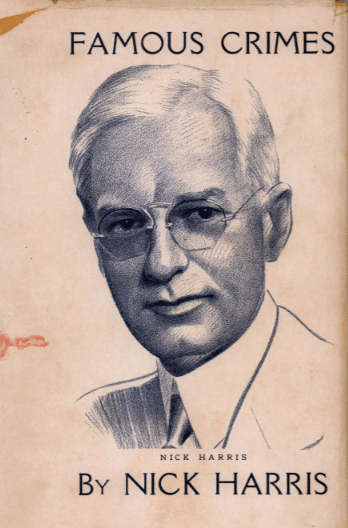
Allan J. and Mary T. Witherell resided in the home in 1929. Witherell was a successful businessman and vice-president of the Hollywood Savings Bank in the 1920s and then became president of a manufacturing company later before his death in 1944. However, his real “claim-to-fame” was the kidnapping of his daughter-in-law, Gladys Julia Witherell who was abducted from her home located at 1843 Whitley Avenue in 1921. Witherell’s son, Otto, 25, and Gladys, 24, where parents of an 18 month old son. According to her neighbor, Elizabeth Warden, Gladys left the baby with her and left with a strange man, indicating she received word her mother-in-law was in terrible car accident. Gladys never returned to pick up the baby or return home. Not only were the police trying to locate Gladys, but the family hired the famed Nick Harris Detective Agency to assist. The detective agency was established in 1906 and exists today and is the oldest detective agency in the country. Harris would go on a publish several books about his famous tales and there was a radio show based on his cases.
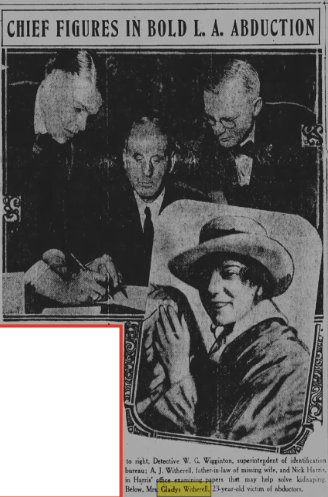
The following day, Otis heard the doorbell at the crack of dawn and found a typed letter under his front door demanding $50,000 or his wife would be killed. The police believed the kidnapping may of been an inside job as the kidnapper(s) knew the family’s background due to the fact that Gladys’ mother recently died from a car accident. The letter read, “Your wife is safe. Don’t worry as you will hear from me. Have $50,000 in cash ready as you will hear from me soon. Don’t inform the police or detectives or all is lost.” For fear that the baby could be abducted, he was heavily guarded at Allan Witherell’s house located at 9023 Fountain Avenue.
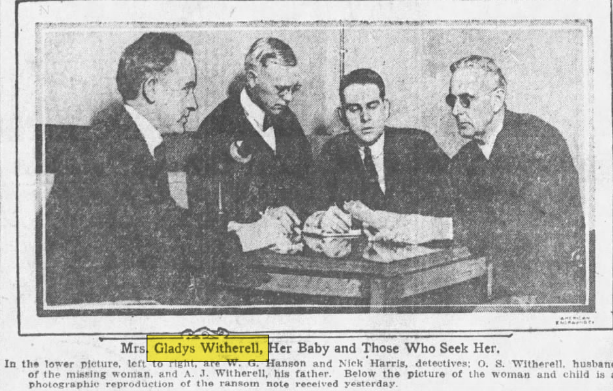
One person of interest, Charles Beverley, an ex-employee of Otis Witherell, was fired from the company after they got into a conflict and Beverley made threats against Witherell. Otis Witherell was president of the Financial Loan and Investment Company. Beverley was put on surveillance by Nick Harris. On the evening of January 28, 1921, Harris was following Beverley in his car and Beverley noticed he was being following and tried to outrun the detectives. Beverley’s car hit a streetcar and he and his passenger, Lita Westren Tenney, were killed instantly. Tenney happened to be Otis’ secretary and the two were dating.

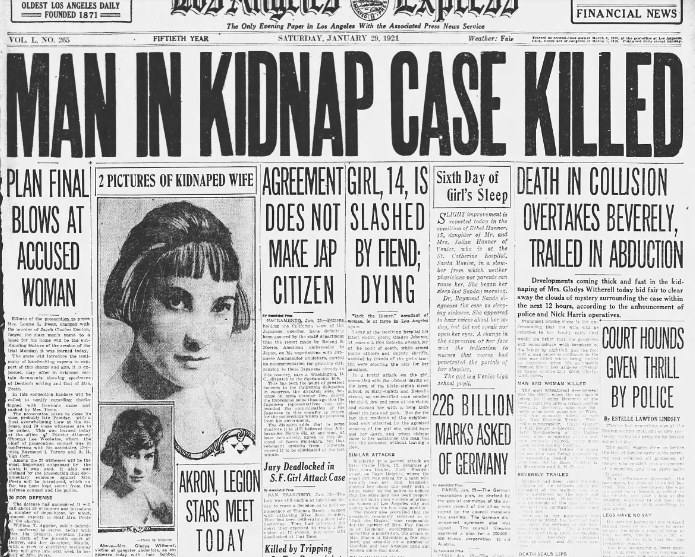
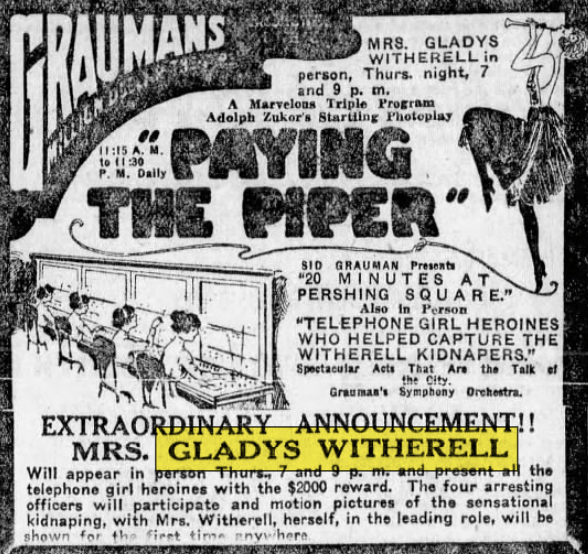
Two days later Gladys Witherell was rescued from a isolated hut in a Santa Ana canyon while one of her abductors were trying to get money from her husband. The kidnappers had written Otis two more times and even had Gladys write her husband in order to get the money. One kidnapper, Arthur W. “Jack” Carr, was arrested at a payphone on East 5th Street while he was on the phone at a drugstore with Otis trying to get the ransom money with the help of the telephone operators who alerted the police about the phone call. Carr did not resist arrest and informed authorities that his cousin, Floyd L. Carr was the “mastermind” in the kidnapping and let the police know where Gladys was. Five cars filled with police, detectives, Otis and Allen Witherell went to the cabin to rescue Gladys. One of the police broke down the cabin door with a sawed-off shotgun and found Gladys in the bed fully dressed. Gladys said, “Don’t hurt me. I haven’t done anything. I am Mrs. Witherell and I want my baby. Please take me away from here if you are a friend”. Floyd Carr came up behind the police officer with his gun and a fight ensued. The other officers rushed into the cabin and overpowered the kidnapper to the ground. Below is Otis and Gladys Witherell upon their return home from the cabin.
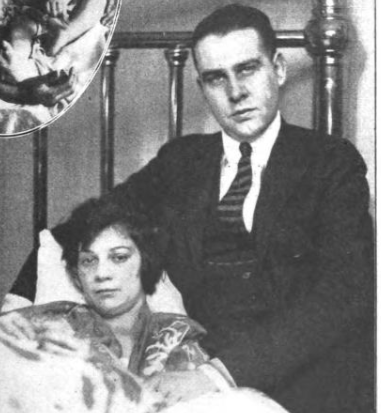
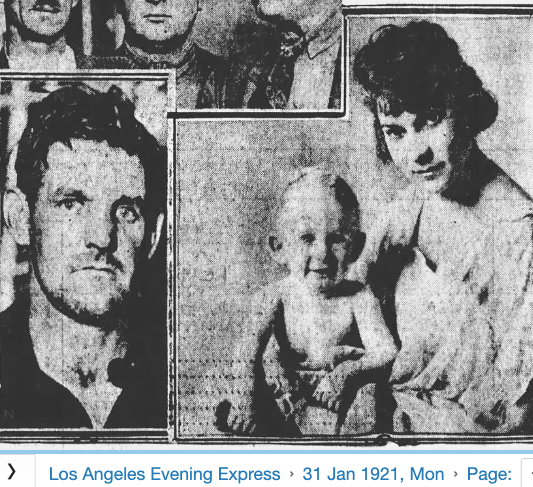
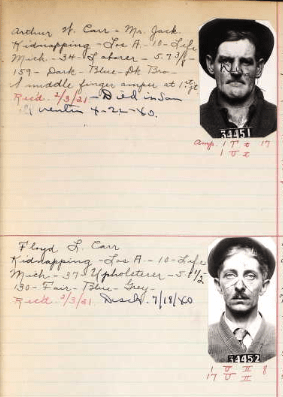
Gladys, who was close to suffering a nervous breakdown, told the police that she was not physically harmed but was watched all the time by one of the men and police believed there were others involved than just the Carrs. Gladys identified Floyd Carr as the “grey old man” who took her away from the home with the fake car accident story. Floyd had used chloroform to put Gladys asleep in the car on the way to the cabin. Both Carrs admitted to the kidnapping due to revenge and a need for money. Arthur Carr indicated that several years ago, Otis Witherell prevented a cousin in getting a fishing boat who was working in a fishing cannery. It was learned that the men kidnapped two other women for money: one in Spokane, Washington and the other in Denver, Colorado. Both men went to jail and had a speedy trial a few days later. Both Arthur and Floyd Carr were both found guilty of kidnapping and sent to prison for 10 years to life. Below is one of the kidnappers, Arthur Carr and Gladys Witherell and her son.
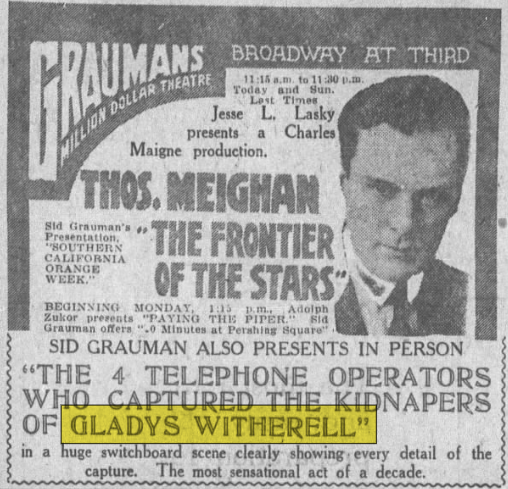
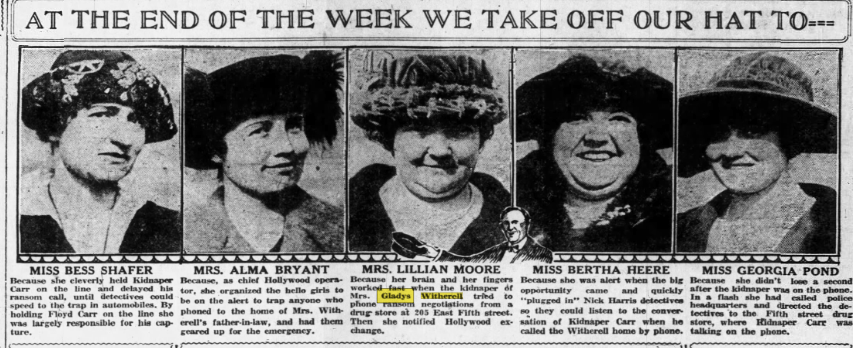
The kidnapping made national news. The reward money was divided among the seven telephone operators who played a significant role in the capture of the Carrs: Bessie Shaeffer, Georgia Pond, Lillian Clark, Bessie Sullivan, Alma Bryant, Lillian Moore and Bertha Heere. The operators kept Arthur on the phone while simultaneously conveying the address of the phone booth he was calling from to the police. On the evening of February 10, 1921 a ceremony to honor the women was held at Grauman’s Theater. Nick Harris, the detective who helped locate Gladys, represented Gladys at the theater because her physician said that she was still too fragile and filled with anxiety to appear in public. On her behalf he handed each of the operators a check for approximately $215 each. All the police officers who worked on the case also received rewards. This story appeared in Nick Harris’ books, “Famous Crimes” and “In the Shadows: Thirty Detective Stories Showing Crime Doesn’t Pay”. The story was also featured in the August 1921 edition of the magazine, “The Wide World”.
Arthur and Floyd Carr were up for parole in 1925 in their 10 years to life prison sentence but were denied. Additionally, they were denied every time they went up for parole. In 1923, one of the sheriffs named Walter Lips, who went to the cabin in the Santa Ana canyon to help save Gladys Witherell, was sent San Quentin Prison for accepting a bribe. Lips happened to be in the same prison as the Carrs. They found out Lips was in prison with them and plotted to kill him. Their plan was thwarted as the warden found out about their plan. To keep Lips away from the other prisoners, he was assigned to work in the prison library. Arthur Carr died in prison on April 21, 1940 at the age of 53. Floyd Carr was “quietly” discharged from prison on July 18, 1940 and he died in Orange County in 1945.
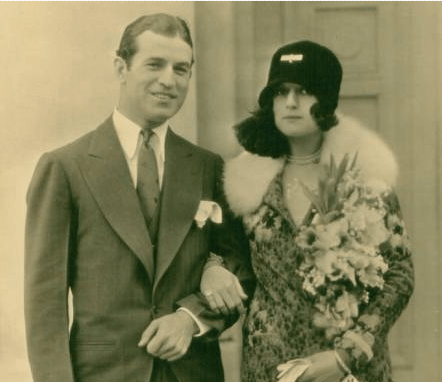
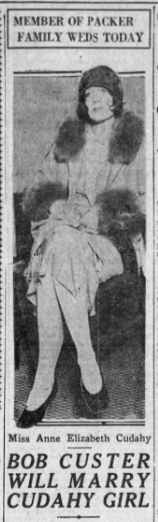
During 1930 and 1931, actor Bob Custer rented 6746 Milner Road. Custer’s real name was Raymond A. Glenn who was born in Kentucky in 1898 and was an actual cowboy who left the range to perform in rodeo shows. Custer then started appearing in western films as he made more money doing so. Custer was credited for 55 films between 1924 to 1937. However, using his real name, he was able to appear in other genres of movies. Custer was not able to transition to talking pictures as he would literally choke on his lines. His best known work was working on the Rin-Tin-Tin movies. After his retirement from films, with a degree in engineering, he worked for the city of Los Angeles as a building inspector, and eventually was appointed Chief Building Inspector for the city of Newport Beach, California.

Custer married his first wife, New York socialite, Anne Cudahy, in 1926. Cuddahy Cudahy was the daughter of Jack Cudahy, son of the Omaha Cudahy-Armour meat packing company. Several newspapers noted the marriage of the cowboy star to the woman who was worth millions of ollars. Cudahy was an avid horse rider who fell in the love with the idea of marrying a real cowboy. In 1928, Raymond Glenn, Jr. was born. However by February of 1933 Cudahy filed for divorce citing cruelty and was granted the divorce in late August of that same year. Cudahy appeared in one film in 1921 called the Barbarian along with her brother, Michael Cudahy. In 1961, Bob Custer was the voice of Broncho Bob in the animated television series of Billy and Butch Bang Bang Movies (there was only two episodes to the show). Custer remarried in 1948 and remain married until his death in 1974.
In 1936 writer, Marjorie Klein and her mother, Helen Klein living at 6746 Milner Road. In 1934 MGM hired Marjorie as a screenwriter. In 1936, Marjorie was credited for writing the screenplay, “A Son Comes Home” with Paramount. She was credited as “contributor to treatment” on the screenplay Crash Conovan in 1936 starring Jack Holt. She was also credited for her work on Crashing Through and Her Majesty, The Governor in 1936. She worked with Jane Hinton to co-write, So This Is Hollywood in 1937. Finally, in 1938, she wrote the screenplay to Inspector Hardy Hits New York with George Yates. Helen was a widower who was married to Manuel Klein, a famed songwriter.
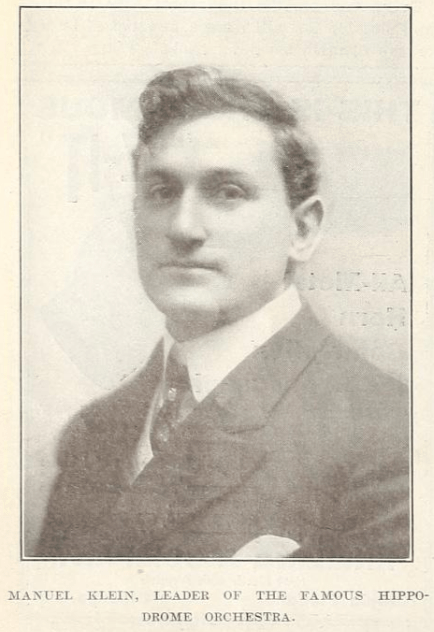
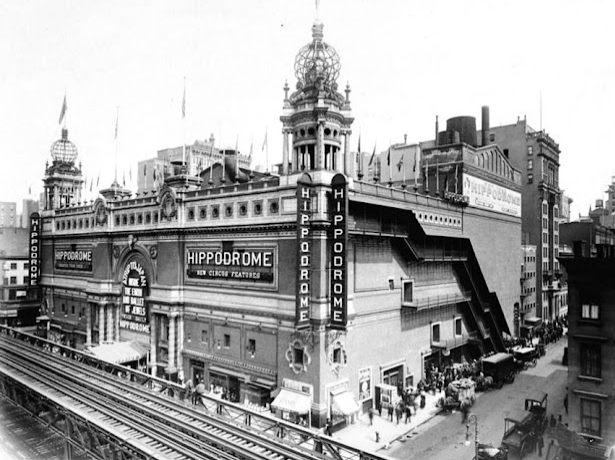
Manuel Klein was born in London in 1876 and moved to New York City in 1896. He became the musical director for a small theater before he focused on composing. In 1905, he became the musical director of the prestigious Hippodrome Orchestra in New York City. Klein also collaborated with L. Frank Baum on The Tik-Tok Man of Oz in 1909. He left the Hippodrome after a dispute with the manager and traveled back to London for a few years. He then returned to New York where he died in 1919 as the result of a previous injury at the bombing of a London theater during the Zeppelin raids in World War 1. His brother was actor Charles Klein who was killed in the sinking of the RMS Lusitania. The family sued the German government for causing both of their deaths. Klein married Helen in 1905 and they had two children: Marjorie and Gerald. After Manuel’s death, Helen trademarked some of her husband’s songs.
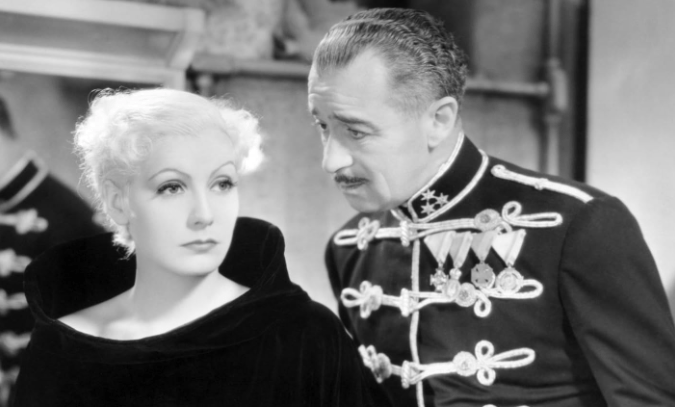
In 1938, actor Albert Conti rented the home. Albert De Conti Cadassamare was born on January 29, 1887 in Trieste, Austria-Hungary (this area is now part of Italy). Conti is credited for 112 parts between 1923 to 1952. He was actually discovered by director Erich von Stroheim who offered him a part in his 1923 film, Merry-Go-Round. Stroheim was fired as the director due to excessive spending-he used a real Viennese street car on the streets of Los Angeles and had the original carriage used by Austrian Emperor Franz Josef, shipped to Hollywood. Conti then had small parts on The Merry Widow (1925) starring John Gilbert and Mae Murray (another Stroheim film), The Eagle (1925) starring Rudolph Valentino, and Tempest (1928) starring John Barrymore. Conti received top billing alongside actress Florence Vidor in the comedy, The Magnificent Flirt in 1928. Conti also had a small part on The Barbarian in 1933; as mentioned earlier, Bob Custer’s wife, Anne Cudahy, also had a small part in that film and lived in this house. Throughout the 1930s and 1940s, Conti was able to get minor roles in movies such as The Black Cat (1934), My Gal Sal (1942), and The Human Comedy (1943). Below, Conti is ween with actress Greta Garbo in “As You Desire Me” in 1932.
In April of 1927, it was announced that Conti would marry Miriam Wherry in a quiet wedding in Los Angeles. He was 40 years old and Wherry was just 21 years old. Wherry worked as an actress under the name. of Patricia Cross. Wherry died just 2 years later in August of 1929 after swallowing poison at her parent’s house in Los Angeles. Before she died, she told authorities that she took the poison to “end the terrifying dreams which had been haunting her constantly. After her death, Conti never publicly spoke about her death. In 1961, Conti married Mary Dutton; he was 74 she was 50 years old. In 1967, Conti died of a stroke in Hollywood at age age of 79.
Robert and Darlene Carroll bought 6760 Milner Road in the late 1990s and resided there for over a decade. Robert Martin Carroll married Dalene A. Young in 1973. He was 25; she was 34. Although they are both in the entertainment industry, Young’s work is probably more well-known. Young was a screenwriter from 1976 to 2002 and worked on the following films: Little Darlings (1980), starring Tatum O’Neal and Kristy McNichol, Cross Creek (1983), starring Mary Steenburgen, and The Babysitter’s Club, starring Rachael Leigh Cook. In addition, Young has wrote scripts for several television movies since the 1970s. Her most recent tv movie was Miss Lettie and Me in 2002 starring Mary Tyler Moore.

 Whitley Heights 101
Leave a comment